
How Bench Warrants Work in Hamilton County
A bench warrant is court process tied to an existing case or court duty. In Hamilton County, common triggers include missing a required appearance, failing to report as ordered, violating a court condition, contempt, or a bond forfeiture. City traffic and ordinance matters can create their own FTA or capias process.
Do not assume that every capias concerns an unpaid fine. Tennessee's official form captions the paper “CAPIAS / BENCH WARRANT,” and the issuing court's wording matters. Ask the clerk which event caused the process and which judge or division controls it.
Hamilton County's CAPIAS/BENCH Form Shows the Return
The blank Tennessee capias form carries a case number, court, county, bond amount, initial appearance date, charge, clerk issuance, and an officer return. The return can mark that a person was found and taken before court or was not found. Those labels describe service; the court still decides whether the order is recalled or the case is resolved.
The form does not establish one Hamilton County number pattern or a public walk-in recall process. Use the case number to ask the issuing clerk about current status.
Source image: the county docket and bond page shows the court-record route.
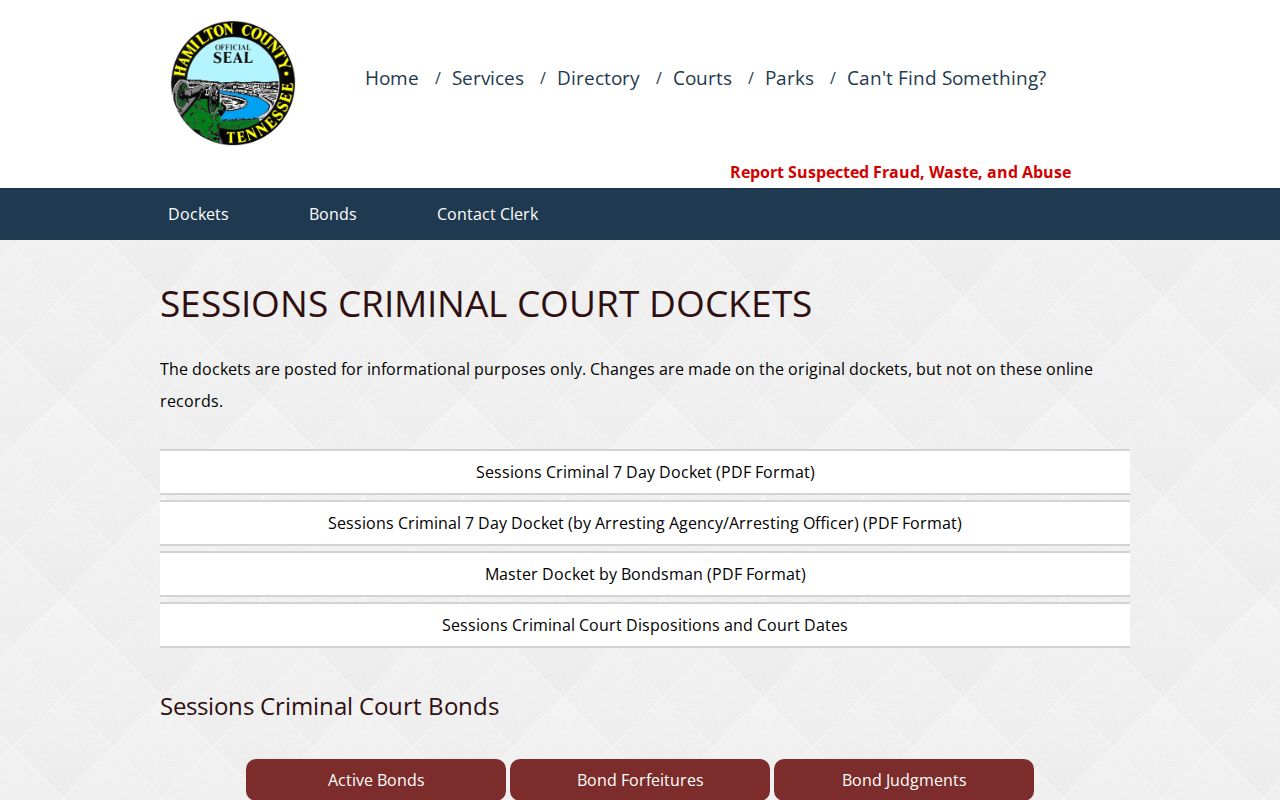
The live docket may contain private case details, so the image is limited to the interface tabs.
Bench Warrant Issuance in Hamilton County
A court records a missed appearance or other failure, then a judge may issue process directing a lawful officer to bring the person before the court. The order is tied to that case. It does not turn into a statewide public portal entry because Tennessee has no public all-warrant search.
The court clerk can identify the next setting, bond instruction, or motion route. HCSO may show a county entry, but its daily feed can lag. The court's current record controls the case action.
Hamilton County Bench Help at the Jail Office
The county Criminal Court Clerk describes a General Sessions Criminal office at the jail as open around the clock for criminal-division purposes. That statement does not promise 24-hour public records service, a lawyer consultation, judge review, or bond payment. Courthouse clerk hours are a separate daytime route.
The clerk's published courthouse page lists Room 102, while Sessions rules identify Room 108 for the Criminal Clerk's Office. Call first and ask which division and room handles the case.
Source image: the Criminal Court Clerk's page lists the public contact and office hours.
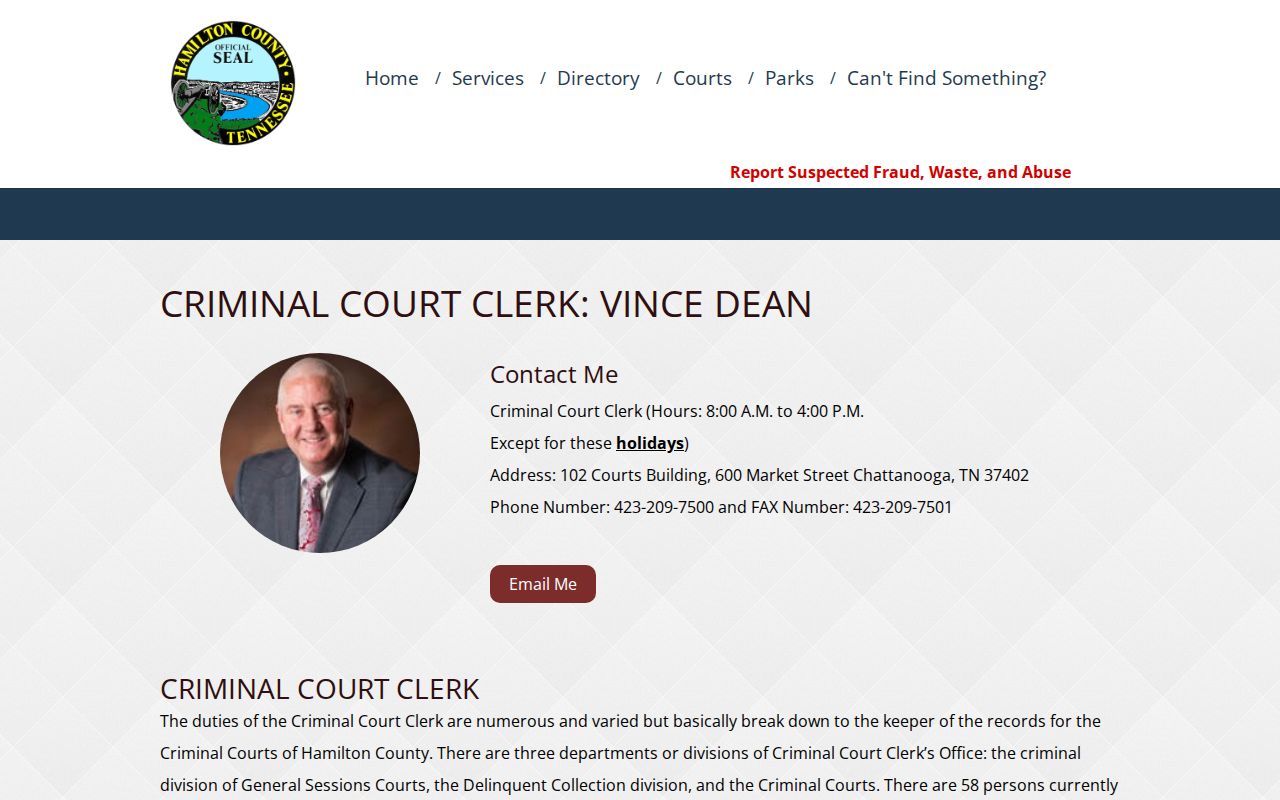
The county clerk handles criminal records and case routing, not every city court's recall decision.
How Bench and Arrest Warrants Differ
Both can authorize custody, but they start at different points. A bench warrant follows a court event in a pending matter. A probable-cause arrest warrant begins with a complaint or affidavit about an alleged offense.
| Feature | Bench Warrant | Arrest Warrant |
|---|---|---|
| Trigger | Missed appearance or court-order issue | Complaint or affidavit with probable cause |
| Authority | Judge handling the pending case | Judge, magistrate, or authorized commissioner |
| Record route | Clerk for the existing docket | Criminal clerk and serving agency |
| Next step | Confirm reset, motion, payment, or bond route | Confirm surrender, bond, and initial appearance |
The Hamilton County arrest warrant process explains the separate probable-cause path.
Hamilton County Bench Warrants After East Ridge Forfeiture
East Ridge's local rules show why the exact trigger matters. Rule 7.04 addresses a defendant's failure to appear, Rule 7.09 covers bail bonds, and Rule 7.10 covers forfeiture and related process. The city's rule says a forfeiture capias remains until apprehension or return to custody and disposition. This is an East Ridge rule, not a countywide formula.
Call the East Ridge clerk before a Tuesday setting to learn whether the case is an FTA, payment matter, or forfeiture hearing. Ask which paper or appearance the court requires.
Source: East Ridge Municipal Court rules publish the local schedule and payment process.
One city's local rule should not be used to predict what Chattanooga, Red Bank, or another court will do.
Clearing a Bench Warrant in Hamilton County
Start by identifying the court and current status. The court may require a new appearance, payment, bond, a motion to recall or quash, or counsel-arranged surrender. No countywide recall form, walk-through window, bond schedule, or guaranteed reset is posted.
- Search HCSO, then call the issuing clerk with your case or citation number and missed date.
- Ask if the matter is still in General Sessions Criminal, has moved to Criminal Court, or belongs to a city.
- Ask whether a lawyer or motion is needed before a new setting, payment, or appearance.
- If surrender is directed, confirm intake and bond instructions with HCSO or counsel first.
- Keep the court order, receipt, release, or new date and ask when the HCSO feed may update.
Caution: No source located states that a Hamilton County bench warrant expires on its own. Ask the issuing clerk or lawyer whether the court has recalled it.
HCSO directs voluntary surrender to the jail at 601 Justice Way, but publishes no public walk-in consultation schedule. Do not assume a clerk can change a judge's order by phone.
Hamilton County City Bench Warrants Follow Different Clerks
City process stays with the city court that set the case. Chattanooga's clerk is at City Court; East Ridge posts its Tuesday dockets; Red Bank asks callers to reach the clerk before noon on a Monday court day. Soddy-Daisy and Collegedale have no public warrant-search form located in the reviewed sources.
Use the court listed on the citation or docket. A county HCSO result may help route the question, but the city judge controls the city's recall, payment, and reset rules.
Hamilton County Courts That Issue Bench Warrants
The court level tells you which clerk to call. General Sessions Criminal handles misdemeanor and traffic judgments plus felony preliminary hearings. Criminal Court handles indicted or presented matters and appeals. Municipal courts control their city ordinance and traffic cases; Juvenile Court uses restricted access rules.
| Case route | First clerk | Use it for |
|---|---|---|
| General Sessions Criminal | Criminal Court Clerk / Sessions office | Missed setting, FTA, preliminary case |
| Criminal Court | Criminal Court Clerk | Indicted, presented, or bound-over case |
| City case | Municipal court clerk | Traffic, ordinance, city FTA, payment |
| Juvenile matter | Juvenile Court Clerk or counsel | Party access under Rule 114 |
The sheriff serves process but does not decide whether the issuing judge recalls it.
A Hamilton County Bench Warrant Does Not Expire on the List
HCSO's daily feed may lag court action and excludes warrants issued before 2008. Tennessee has no single public statewide warrant search to fill that gap. If a prior case or missed date does not show online, ask the likely clerk to check the docket.
For a county criminal case, the Criminal Court Clerk can confirm the division and next setting. For a city citation, ask the municipal clerk whether a separate capias or appearance is still required.